
- Retinal Degeneration: Dry AMD is a leading cause of permanent vision loss, traditionally managed only with limited-efficacy nutritional supplements.
- Mitochondrial Dysfunction: The retina is highly rich in mitochondria. As cells age, mitochondrial efficiency plummets, triggering cell death.
- Drusen Accumulation: Metabolic waste material (drusen) accumulates beneath the retinal pigment epithelium (RPE), suffocating vital photoreceptors.
- The Treatment Gap: Historically, no therapeutic options existed to actively restore cellular metabolism or reverse intermediate dry AMD tissue breakdown before advanced atrophy set in.
The Science — What is Photobiomodulation (PBM)?
- Mechanism of Action: PBM uses precise, low-level light energy to target and stimulate compromised cellular functions rather than generating tissue-damaging heat.
- Photoacceptor Activation: Light photons are directly absorbed by Cytochrome c Oxidase (CcO), a crucial molecule inside the mitochondrial electron transport chain.
- Energy Synthesis: Activating CcO drives the proton gradient required to upregulate Adenosine Triphosphate (ATP) production.
- Secondary Cellular Effects:
- Enhances local blood flow via local nitric oxide release.
- Triggers a temporary, safe spike in reactive oxygen species (ROS) to initiate self-repair.
- Inhibits systemic inflammation and prevents early apoptotic retinal cell death.
The Tool — The Valeda® Light Delivery System
- FDA Milestone: Authorized by the FDA via the De Novo pathway, making it the first and only non-invasive treatment indicated to improve visual acuity in dry AMD.
- Multiwavelength Delivery: Simultaneously or sequentially delivers three distinct, clinical-grade wavelengths directly to the retina:
- 590 nm (Yellow): Stimulates nitric oxide synthesis, maximizing local oxygen and nutrient delivery through vasodilation.
- 660 nm (Red): Promotes oxygen binding, drives ATP production, and dampens pathways linked to inflammation.
- 850 nm (Near-Infrared): Enhances deep electron transfer within cell layers to halt photoreceptor breakdown.
- Delivery Method: Applied painlessly directly through open eyelids (590 nm/850 nm) and closed eyelids (660 nm).
Clinical Application & Protocol
- Patient Selection: Most effective for patients in the early to intermediate stages of dry AMD with notable drusen deposits before extensive geographic atrophy develops.
- Treatment Cycle:
- Intensive initial series: 9 distinct in-office sessions.
- Compressed timeline: Administered 3 times per week across a 3-week window.
- Session duration: Fast and painless, requiring less than 5 minutes per treated eye.
- Maintenance Schedule: The full 9-session treatment cycle is repeated every 4 months to sustain metabolic improvements.
Clinical Trial Data — The LIGHTSITE III Trial
- Study Design: A rigorous multi-center, double-masked, randomized, sham-controlled trial evaluating 148 eyes over a 24-month period.
- Primary Metric Baseline: Subjects presented with early-to-intermediate dry AMD and baseline visual acuity across standard letter lines.
- Key Findings:
- Met its primary endpoint with statistically significant gains in Best-Corrected Visual Acuity (BCVA).
- 55% of PBM-treated eyes experienced a significant boost of ≥ 5 letters (1 full line) on an eye chart by Month 13.
- Placebo (sham) cohorts exhibited no significant improvements or demonstrated steady vision decline.
Visualizing the Outcomes — Vision Gains & Loss Prevention
The table below breaks down the long-term changes in Best-Corrected Visual Acuity (BCVA) observed between the multiwavelength PBM treatment group and the sham control arm at Month 13.
| Clinical Metric Observed (Month 13) | Valeda® PBM Group | Sham Control Group |
|---|---|---|
| ≥ 5 Letter Gain (~1 Line) | 55.0% of eyes (Mean gain: 9.7 letters) | 40.8% of eyes |
| ≥ 10 Letter Gain (~2 Lines) | 26.4% of eyes (Mean gain: 12.8 letters) | 14.9% of eyes |
| ≥ 15 Letter Gain (~3 Lines) | 5.5% of eyes | 1.9% of eyes |
| Vision Loss Metrics | Significantly fewer eyes lost letters | Higher frequency of letter loss (-1 to -15 letters) |
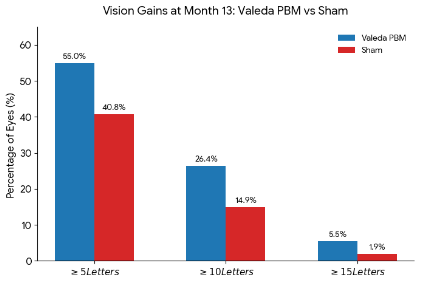
Visual Acuity Shift (PBM vs. Sham Control)
The chart below tracks the percentage of eyes experiencing significant vision gains at the primary 13-month trial checkpoint, illustrating Valeda’s therapeutic edge over standard sham groups.
Anatomical Outcomes & Disease Modification
- Drusen Management: Unlike historic management plans, Valeda achieves true anatomical stabilization or reduction of central drusen volume and thickness.
- Slowing Progression: PBM substantially lowers the historical rate of progression to late-stage devastating conditions:
- Delays onset of Geographic Atrophy (GA) (advanced dry AMD tissue death).
- Reduces conversion rates to exudative (Wet) AMD.
- Extended Efficacy: Recent long-term extension data indicates that continuous regular maintenance therapy shifts the long-term trajectory of vision loss out to 4.5 years.
Patient Safety & Tolerability Profile
- Non-Invasive Safety: No injections, structural incisions, or surgical risks involved.
- Phototoxicity Results: Zero documented cases of phototoxicity across the extensive LIGHTSITE trial programs.
- Comfort: 100% of trial patients reported completely pain-free treatment sessions without discomfort.
- Contraindications: Not recommended for patients presenting with extreme clinical photosensitivity or individuals taking light-activated pharmaceuticals.
Conclusion & The Future of AMD Management
- A New Standard of Care: The Valeda® System shifts intermediate dry AMD care from passive observation via vitamin supplements to active cellular restoration.
- Proven Efficacy: Clear, verified improvements in central vision, contrast sensitivity, and drusen stabilization.
- Clinical Integration: Easily deployed within current retinal practices to stop vision loss before permanent cell death takes place.
Valeda™ PBM’s unique mechanism of action works to restore cellular energy production and improve retinal cellular health
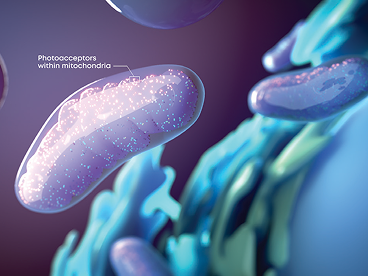
The retina is rich in mitochondria, and mitochondrial dysfunction is a known cause of vision loss in dry AMD.
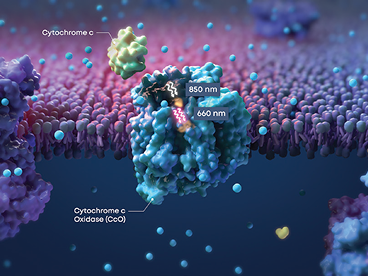
Cytochrome c oxidase (CcO) is a key photoacceptor in the mitochondrial electron transport chain.
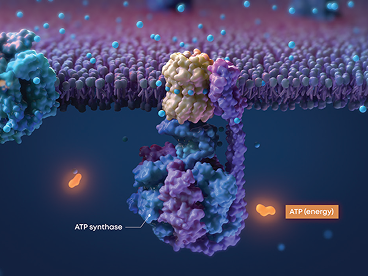
Valeda™ PBM wavelengths activate CcO, enhancing electron transport and mitochondrial adenosine triphosphate (ATP) production, the cell’s major source of energy.